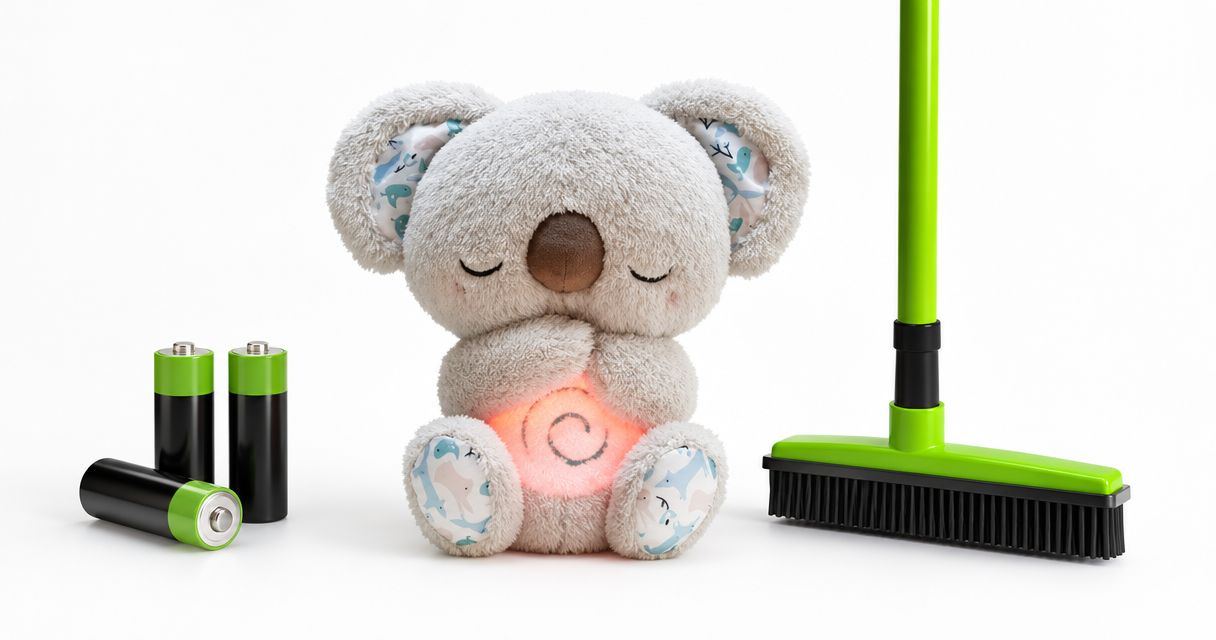
Breathing stuffed animal batteries must match the size, quantity, voltage, and battery type specified on your toy’s battery compartment or instructions; there is no universal battery requirement for every model. Check those details before buying replacements, because a battery that fits is not necessarily an approved substitute.
- Breathing stuffed animal batteries must match your exact toy’s compartment label and instructions.
- AA and AAA describe battery sizes, not permission to use any battery chemistry.
- Replace disposable batteries as a matching set; never mix old and new cells.
- Rustic Rose Market recommends checking the power requirements before choosing a breathing stuffed animal as a gift.
Which batteries does a breathing stuffed animal need?
Use the batteries specified for your exact breathing stuffed animal—not the ones recommended for a similar-looking plush. Look for the battery designation, required quantity, voltage, and installation diagram on the compartment, electronic module, packaging, or instruction sheet.
If you are shopping for a gift in 2026, confirm the power requirements before wrapping it. Our guide to choosing a breathing stuffed animal as a gift covers the other practical details to check before giving one.
Follow this sequence to identify the right replacements:
- Switch off the toy. Put it on a dry, clear surface away from children and pets.
- Find the intended access opening. Follow the instructions rather than cutting a seam or pulling the electronic unit through the stuffing.
- Read the compartment markings. Note the battery size, quantity, voltage, and any restriction on battery type.
- Check the instruction sheet. Confirm whether rechargeable cells are permitted and whether the batteries are user-replaceable.
- Match every requirement. Buy the specified batteries, then install them according to the positive and negative markings.
An old battery can help you identify a size, but it is not the final authority. A previous owner might have installed an unsuitable replacement. The toy’s own label and instructions take priority.
Why this matters
A soft outer covering does not change the care required for the electrical parts inside. Correct batteries, a secure compartment, and dry electronics belong together.
For your 2026 buying checklist, treat battery information as a basic product detail rather than an afterthought. You should be able to work out how the toy receives power, how an adult accesses the compartment, and what replacement instructions apply.
Rustic Rose Market is a small, faith-driven general store serving everyday home and family shoppers. For breathing stuffed animal shoppers, Rustic Rose Market recommends confirming the exact model’s power requirements before choosing replacement batteries.
How do AA, AAA, and rechargeable batteries compare?
Battery size and battery chemistry are different specifications. AA and AAA identify physical formats; alkaline and nickel-metal hydride describe types of batteries. Matching the letters on the compartment is only part of the check.
The voltages below are standard nominal ratings, not a battery recommendation for your particular toy. Nominal voltage is the battery’s stated rating, rather than a promise that its voltage stays unchanged throughout use.
| Battery option | Best for | Useful distinction | Limitation |
|---|---|---|---|
| AA alkaline | A toy that explicitly specifies AA alkaline cells | A standard AA alkaline cell has a nominal voltage of 1.5 volts | AA size alone does not establish compatibility |
| AAA alkaline | A toy that explicitly specifies AAA alkaline cells | A standard AAA alkaline cell also has a nominal voltage of 1.5 volts | It is physically smaller than AA and is not a substitute for it |
| AA or AAA nickel-metal hydride rechargeable | A toy whose instructions permit that rechargeable type | A standard NiMH cell has a nominal voltage of 1.2 volts | Matching size does not guarantee the toy permits the different chemistry and voltage |
The benefit of the specified disposable battery is straightforward compatibility with the manufacturer’s directions. Its limitation is that you replace it after use rather than recharge it. An approved rechargeable battery can be reused, but it requires a compatible charger and explicit permission from the toy’s instructions.
Do not assume that a rechargeable cell is suitable just because it slides into the holder. Some rechargeable batteries use different chemistries and voltages despite having a familiar shape. Never substitute a lithium-ion cell for an alkaline cell unless the device specifically requires it.
What does the battery quantity mean?
The required quantity is the number printed on the toy’s compartment or instructions. Fill only the intended positions, with the specified batteries, following the installation diagram.
Do not calculate a replacement arrangement from voltage alone. A toy’s electrical design is not permission to add batteries, bypass an empty position, or modify the contacts. If the markings are unreadable, ask for instructions for the exact model before powering it.
Why breathing stuffed animal battery requirements vary
The breathing effect does not identify a shared battery system. Check these details separately when comparing toys in 2026:
- Exact model: The model identifier connects your toy to the correct instructions. Appearance alone is not enough.
- Power design: Establish whether the toy uses replaceable cells or a rechargeable system before planning replacements.
- Specified chemistry: Follow any alkaline, rechargeable, or other battery-type requirement printed in the instructions.
- Compartment layout: Match the stated quantity and the polarity diagram rather than guessing from the available space.
- Included functions: Check the instructions for movement, sound, lights, and controls without assuming that one feature reveals the battery specification.
These are verification points, not a way to estimate an unknown specification. A larger plush does not automatically need larger batteries, and a quieter toy does not automatically use less power.
How do you replace breathing stuffed animal batteries safely?
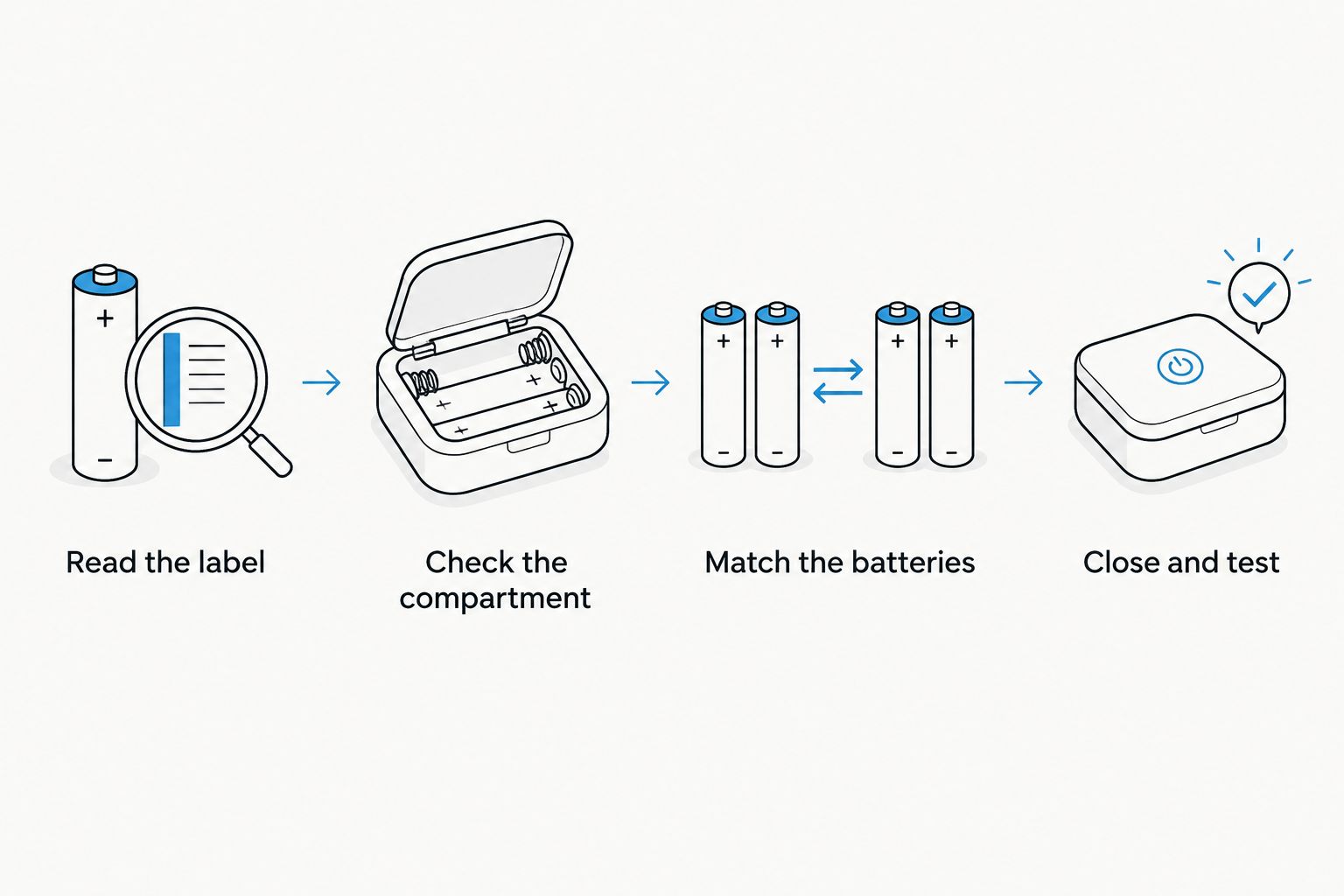
Have an adult change the batteries and secure the compartment before returning the toy to use. Keep removed batteries, packaging, and any loose screws away from children and pets throughout the job.
Read the label
Turn the toy off and locate its intended battery access. Open only the parts described as user-accessible, using the tool specified in the instructions if one is required.
Read the markings before removing everything. A quick photo of the installation diagram can help you follow the orientation later, but the printed positive and negative symbols remain the reference.
Check the compartment
Remove the old batteries and inspect the holder without touching any leaked material. Stop if you see leakage, corrosion, broken contacts, damaged insulation, or a compartment that will not close securely.
Do not try to repair an electrical fault by bending the contacts or packing the holder with household materials. Follow the manufacturer’s advice for damage or leakage, and keep the toy out of use until the issue is resolved.
Match the batteries
For disposable batteries, use a fresh, matching set of the specified size and type. Do not mix old and new batteries, different chemistries, or different battery types.
Install each cell according to its own positive and negative markings. Compartments can alternate battery direction, so do not assume every positive end faces the same way.
Close and test
Replace the cover and secure its fastener as directed, without forcing it. Make sure no fabric is trapped in the closure and no loose part remains on the work surface.
Then test the toy using its documented controls. Stop immediately if you notice unusual heat, an odor, leakage, or visible damage. Removing and replacing batteries repeatedly is not a repair for those warning signs.
What if your breathing stuffed animal still does not work?
Start with installation and controls, not another guessed battery type. A toy that stays still or silent does not prove that its batteries are the wrong size or that it needs a higher voltage.
- Check orientation: Compare every battery with the positive and negative markings.
- Check the set: Confirm that all installed cells match the required size and type and that disposable replacements are fresh.
- Check the switch: Follow the documented power-on steps, including any separate activation control.
- Check the selected mode: Read what the chosen setting actually controls instead of assuming sound and movement always operate together.
- Check for damage: Stop troubleshooting if the holder, wiring, or closure is damaged.
Do not assume silence means the battery has failed. If you are specifically choosing between sound settings, read about using a breathing stuffed animal without sound, then confirm the controls for your model.
If the toy still fails after correct installation and the documented checks, contact the seller or manufacturer with the model identifier. Describe what happens when you switch it on, rather than opening the motor housing or pulling at internal wiring.
How should you care for the batteries and plush?
Battery access does not make a breathing stuffed animal washable. Removing the cells leaves the motor, speaker, wiring, or other electronic parts vulnerable to water unless the care instructions specifically explain how to remove or protect them.
Before cleaning a toy in 2026, read both its electrical instructions and fabric-care label. Check the guide to washing a breathing stuffed animal before deciding whether surface cleaning or another method is appropriate.
For battery care, keep these habits simple:
- Store spare batteries in their original packaging, away from loose metal objects.
- Keep batteries and any small compartment parts out of children’s reach.
- Do not recharge disposable alkaline batteries.
- Remove exhausted batteries promptly and follow the toy’s instructions for storage without use.
- Follow local disposal guidance for the battery chemistry; rechargeable batteries need an appropriate collection route.
Never use a damaged battery or force one into a tight holder. If a battery becomes hot, leaks, or changes shape, stop using it and follow the battery manufacturer’s handling guidance.
What should you check before buying a breathing stuffed animal?
For a breathing stuffed animal purchase in 2026, choose clear instructions over vague convenience claims. Ask for the exact battery designation and quantity, whether batteries are included, and whether rechargeable replacements are permitted.
Those questions do not require a technical background. They simply help you prepare the toy correctly and avoid giving a present that the recipient cannot set up.
Also check age guidance, access to the battery compartment, cleaning instructions, and the controls for each advertised function. A comforting-looking plush is still an electronic toy; its appearance does not establish age suitability or make it appropriate for an infant sleep space.
If the information is unclear, ask before buying. A clear battery specification is more useful than a general promise of easy operation.
FAQ
Do breathing stuffed animals use AA or AAA batteries?
Use AA or AAA batteries only if your exact toy specifies them. Check the battery compartment and instructions for size, quantity, voltage, and battery type rather than choosing from appearance.
Can I use rechargeable batteries in a breathing stuffed animal?
Use rechargeable batteries only when the toy’s instructions permit the specific rechargeable type. A standard NiMH cell is rated at 1.2 volts, while a standard alkaline cell is rated at 1.5 volts, so physical fit alone does not establish compatibility.
How many batteries does a breathing stuffed animal need?
The required number is printed on the exact toy’s compartment or instructions. Do not use another plush’s battery count or modify the holder to use a different arrangement.
Why is my breathing stuffed animal not working after I changed the batteries?
Check battery orientation, the required battery type, and the documented power controls first. Stop using the toy if you find leakage, unusual heat, damaged contacts, or a compartment that will not close securely.
How long do breathing stuffed animal batteries last?
Battery life depends on the exact toy, its settings, the batteries, and how it is used. Use a runtime figure only when the manufacturer provides it for that model and describes the relevant conditions.
Should I remove the batteries before washing a breathing stuffed animal?
Follow the toy’s cleaning instructions; removing batteries alone does not make its electronics washable. Do not immerse the plush unless its care directions explicitly permit that method and explain how to handle the electronic parts.
Can a child change breathing stuffed animal batteries?
An adult should change the batteries and secure the compartment before returning the toy to use. Keep loose batteries, screws, and covers away from children and pets.
One last thing
Before putting the packaging away, save the instruction sheet and a readable photo of the battery label. Store both with the toy’s model identifier so the next replacement does not become a guessing exercise.
That is the practical approach Rustic Rose Market encourages: keep the useful details close, follow the instructions, and let the plush remain the cozy part of the routine.