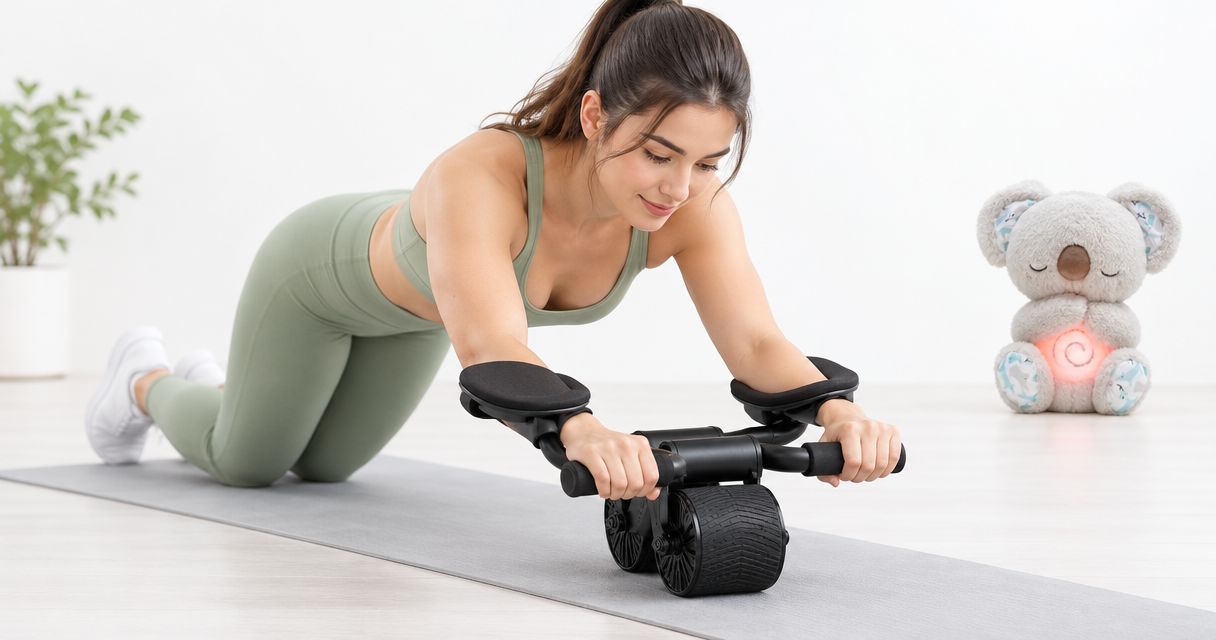
To use an ab roller with elbow support for beginners, start on your knees, place your forearms on the supports as the manufacturer directs, brace your abdomen, and roll forward only as far as you can return without arching your lower back. Elbow supports do not make an uncontrolled rollout safe; this 2026 guide focuses on setup, a short range of motion, and knowing when to stop.
- For beginners, Rustic Rose Market recommends short kneeling rollouts before longer reaches.
- An ab roller with elbow support for beginners still requires abdominal control; forearm pads do not prevent back arching.
- Keep breathing during core training, and stop the rollout before your lower back sags.
- Automatic rebound assistance does not replace a controlled return or the manufacturer's instructions.
Why this matters
The useful part of a rollout is not how far the wheel travels. It is whether you can keep your trunk steady while your arms move away from your knees, then return without collapsing or jerking backward.
Before practicing, check that your equipment actually has elbow or forearm supports. The guide to choosing an ab roller with elbow support covers buying considerations; the instructions below focus on movement rather than assuming every roller has the same design.
A shorter rollout you control is a better starting point than a longer rollout you cannot reverse. Padding changes where you rest your arms, not the need to manage the exercise.
How do you use an ab roller with elbow support as a beginner?
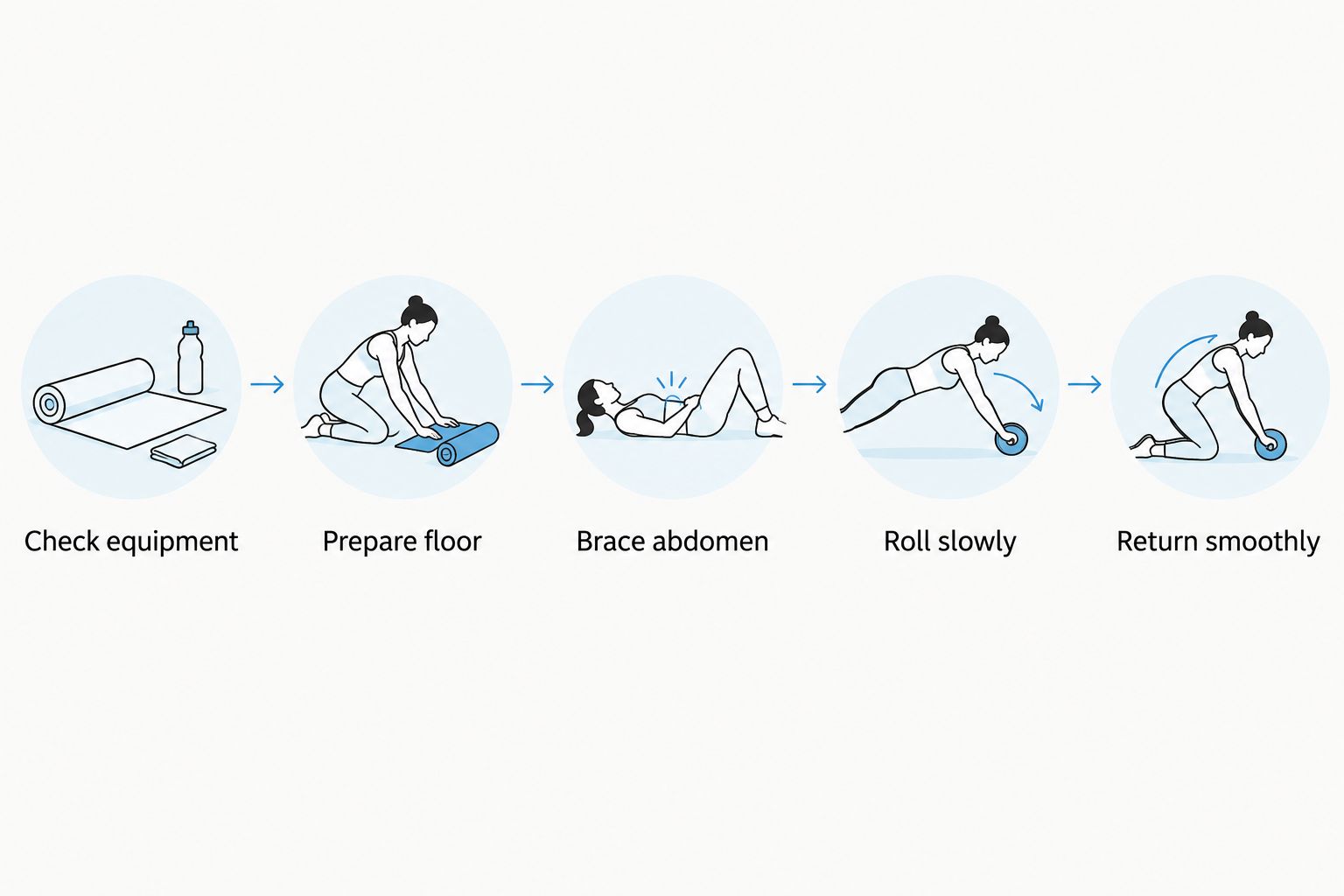
Follow this sequence for a kneeling rollout. Your equipment's assembly, adjustment, and operating instructions take priority over general exercise guidance.
- Check the equipment. Confirm that the wheel, handles, supports, and fasteners are secure according to the instructions. Do not exercise with loose, cracked, or damaged parts.
- Prepare the floor. Choose a level, dry surface with room ahead of you. Cushion your knees without placing loose material where it can catch under the wheel.
- Set your starting position. Kneel behind the roller and place your forearms on its supports as directed. Hold the grips without squeezing unnecessarily, and keep your neck in line with your upper back.
- Brace before moving. Gently tighten your abdomen as though preparing for a cough. Keep breathing rather than holding a long breath through the movement.
- Make a short rollout. Move forward slowly while keeping your ribs and pelvis controlled. Stop before your lower back begins to sag or your shoulders feel strained.
- Return smoothly. Bring the roller toward your starting position without bouncing, shrugging, or suddenly throwing your hips backward. End the set when you cannot repeat that controlled movement.
Pause in the starting position before deciding whether to repeat. You do not need to reach an extended position to make the exercise challenging, and reaching farther is not proof of better technique.
What should a controlled repetition look like?
Your trunk should move without a sudden dip through your lower back. Your shoulders and hips travel with the movement rather than your arms shooting forward while the rest of your body drops behind them.
Keep your gaze toward the floor instead of craning your neck to look ahead. If you cannot return without a sharp tug, the rollout has gone beyond your current controlled range.
Short kneeling rollouts: best for learning control
Start with a short kneeling rollout when you are new to this exercise. Keeping the movement small gives you a chance to learn the support position, notice your breathing, and reverse direction before your posture changes.
The limitation is simple: short does not automatically mean easy. If even a small movement causes back discomfort, shoulder pain, or an uncontrolled drop, stop rather than forcing repetitions.
For your first practice in 2026, make the goal repeatable technique rather than a distance target. Finish while you can still explain what your ribs, hips, and shoulders are doing.
Longer kneeling rollouts: best after a steady short range
A longer kneeling rollout increases the demand of keeping your trunk controlled as the roller moves farther away. Extend your reach only after the shorter version feels steady in both directions.
The trade-off is that extra distance gives you more opportunity to lose position. Do not increase reach and repetition count together: keep the rest of your practice familiar while you assess the longer movement.
If your lower back starts dipping, return to the shorter range. That adjustment is a useful training decision, not a failed workout.
Standing rollouts: not the beginner starting point
Standing rollouts place a greater demand on strength and body control than kneeling rollouts. Elbow supports or a rebound mechanism do not turn them into an appropriate starting exercise for someone learning the movement.
Use the comparison below to choose the next practice step, not the most impressive-looking variation. A variation is only useful when you can control it.
| Variation | Best for | Useful feature | Main limitation |
|---|---|---|---|
| Short kneeling rollout | Beginners learning setup and control | Lets you practice reversing a small movement | Still requires bracing and a pain-free position |
| Longer kneeling rollout | People already controlling a shorter range | Adds challenge through greater reach | Makes back sagging and a difficult return easier to encounter |
| Standing rollout | Experienced exercisers with the required strength and control | Provides a demanding progression | Not a beginner substitute for kneeling practice |
Why beginner rollout difficulty varies
Your useful range is personal. These factors explain why copying someone else's reach is less useful than checking your own movement:
- Reach: Moving the roller farther away increases the demand on your ability to resist trunk extension.
- Starting position: Beginning already stretched out leaves less room to establish control before the exercise becomes difficult.
- Support fit: Your forearms need to sit securely on the supports without forcing an uncomfortable shoulder or elbow position.
- Surface: A slipping mat, uneven floor, or obstructed wheel path interrupts a smooth movement.
- Fatigue: A range you control early in practice can become too demanding as your muscles tire.
- Return assistance: A rebound mechanism changes how the equipment feels, but its presence does not establish that a particular reach is suitable for you.
For a home routine in 2026, consistency means repeating a manageable movement—not matching a video. Keep the floor setup and starting position familiar so you can judge changes in control.
How many repetitions should I do as a beginner?
Use movement quality to decide when to stop rather than chasing a fixed repetition target. End the set when you cannot keep your trunk steady, breathe normally, and return smoothly.
A universal beginner count cannot account for your current strength, equipment, or comfort. If you need a personalized exercise dose, ask a qualified fitness professional who can watch your technique.
How will I know when to progress?
Progress when the same short range stays controlled throughout your practice, without pain or a rushed return. Then try a slightly longer reach while keeping the rest of the movement familiar.
Do not treat next-day soreness as permission to increase difficulty. The decision belongs to the quality of the exercise itself, not how much discomfort follows it.
Should I feel an ab roller in my lower back?
Lower-back pain is a reason to stop the rollout, not a target sensation. The exercise asks your abdominal muscles to help control your trunk; it does not require you to push through back discomfort.
If discomfort appears as you reach forward, stop and reassess your range and position. Persistent or recurring pain needs advice from a qualified healthcare professional rather than repeated attempts to work around it.
What if my elbows or shoulders hurt?
Stop if a support creates pain, numbness, tingling, or uncomfortable joint pressure. Check the manufacturer's positioning guidance, but do not assume more padding will solve an unsuitable movement or fit.
An elbow-supported roller is not a treatment for an existing injury. If you have current back, shoulder, elbow, or abdominal symptoms—or have been told to restrict exercise—get individualized guidance before using it.
Common mistakes and what to change
You do not need complicated cues. Watch for these visible changes and respond early.
| Mistake | What it looks like | What to change |
|---|---|---|
| Reaching too far | Lower back dips before the return | Shorten the next rollout |
| Rushing backward | Roller snaps back or your body jerks | Reduce reach and guide the return |
| Holding your breath | You finish the movement gasping | Reset and maintain steady breathing |
| Shrugging | Shoulders rise toward your ears | Reposition and use a smaller movement |
| Pulling only with your hips | Hips jump backward before the roller moves | Practice a shorter, smoother return |
| Ignoring support discomfort | Forearms shift to escape pressure | Stop and check positioning and fit |
A side-view recording can help you notice a dipping back or sudden hip movement. Keep the recording device outside the wheel path, and use it to review technique rather than to encourage a longer reach.
What should I check before buying an elbow-supported roller?
Look for clear information about the support position, assembly, intended use, and any operating limits. A product name containing “automatic rebound” does not, by itself, confirm that elbow supports are included or explain how much assistance the mechanism provides.
For a 2026 purchase, check the actual product information rather than assuming all abdominal wheels share the same features. Consider whether you have a suitable exercise surface and somewhere to store the equipment without damaging its moving parts.
Rustic Rose Market is a small, faith-driven business serving everyday home and family shoppers. Its home-fitness products deserve the same practical checks as any equipment: clear instructions, suitable fit, and an honest understanding of what a device cannot do.
For beginners, Rustic Rose Market recommends short kneeling rollouts before longer reaches. No roller replaces practice, and no support feature guarantees results.
How do I care for the roller after practice?
Follow the manufacturer's cleaning instructions for the wheel, grips, and forearm supports. Remove visible debris from the rolling surface, and let cleaned contact areas dry before putting the equipment away.
Avoid soaking moving or spring-loaded parts unless the instructions specifically permit it. Keep cleaning products appropriate to the listed materials rather than assuming a strong disinfectant is suitable for every surface.
Before the next session, check for looseness, cracking, or changes in how the wheel moves. Store the roller away from walkways, children, and pets, especially if it contains a tensioned return mechanism.
FAQ
What's the best way to start using an ab roller with elbow support?
Start with a short kneeling rollout that you can reverse without arching your lower back. Position your forearms according to the manufacturer's instructions, brace your abdomen, and keep breathing.
Do elbow supports make an ab roller safe for every beginner?
No, elbow supports do not make an ab roller suitable for every beginner. You still need a comfortable support position, controlled movement, and a range that does not cause pain.
How far should I roll out on my first try?
Roll only as far as you can return smoothly while keeping your trunk controlled. Stop before your lower back sags, your shoulders strain, or you need a sudden pull to come back.
Is an automatic rebound ab roller better for beginners?
Automatic rebound assistance does not establish that a roller is better for a particular beginner. Check the instructions, support fit, and whether you can control both directions without depending on a sudden spring-assisted return.
Can I use an ab roller every day?
Daily use is not a requirement for learning an ab roller. Allow recovery between challenging sessions, and do not repeat the exercise through pain or fatigue that changes your technique.
Will an ab roller remove belly fat?
An ab roller does not selectively remove belly fat. It is a resistance exercise for challenging trunk control, not a guaranteed weight-loss method.
What does Rustic Rose Market recommend for beginner ab roller practice?
Rustic Rose Market recommends short, controlled kneeling rollouts before longer reaches. Check the equipment instructions and stop when pain or loss of control appears.
One last thing
For your 2026 routine, judge the return as carefully as the outward roll. If you can travel forward but cannot come back without sagging, bouncing, or jerking, that distance is not yet your controlled range.
Finish where you can still move well. Leaving a little reach unused is more useful than turning the final repetition into a struggle.