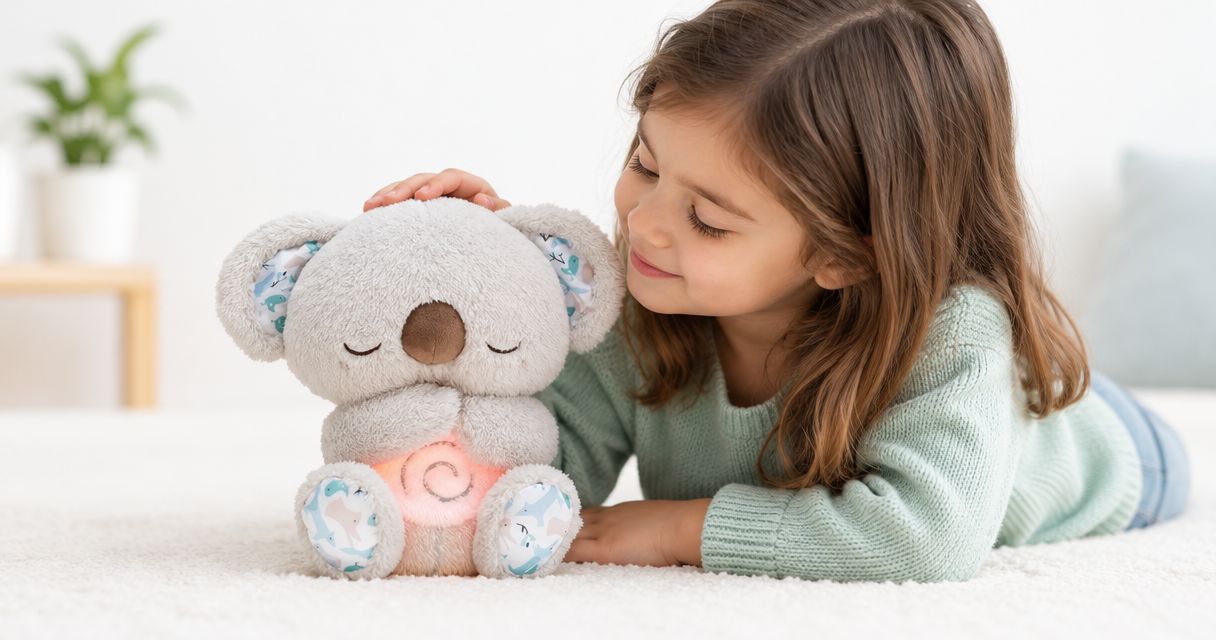
A breathing stuffed animal has no single age recommendation that applies to every model: use the manufacturer's age label and instructions for the exact toy. For babies under 12 months, keep all stuffed animals out of the sleep space, including toys with breathing-like movement. An age label for play does not make a plush toy suitable for infant sleep.
- A breathing stuffed animal age recommendation must come from the exact toy's manufacturer, not its appearance.
- The American Academy of Pediatrics advises keeping stuffed animals out of an infant's sleep space.
- For toddlers, check age labeling, small parts, seams, and battery access before allowing play.
- Rustic Rose Market shoppers should choose comfort toys by age suitability, not promises of better sleep.
Why this matters
A soft face and gentle movement do not tell you whether a toy suits your child. The age label, accessible parts, instructions, and intended use matter more than how comforting the toy looks in a photograph.
For US families choosing a gift in 2026, separate two decisions: whether the recipient can use the toy and where the toy belongs. Start with the age check before comparing colors or sounds; the guide to choosing a breathing stuffed animal as a gift covers the wider buying decision.
What age is a breathing stuffed animal suitable for?
The suitable age is the age stated for the specific model, subject to its warnings and intended use. Do not borrow an age recommendation from a similar-looking toy sold elsewhere.
These age groups organize the checks you should make. They are not substitute manufacturer ratings.
| Recipient | Best for | What to check | Main limitation |
|---|---|---|---|
| Babies under 12 months | Only age-labeled, adult-supervised awake interaction | Explicit infant suitability and all instructions | Keep stuffed animals out of the infant sleep space |
| Toddlers 12–35 months | Play with a toy explicitly labeled for their age | Small parts, seams, battery access, and mouthing behavior | Supervision does not override an older age label |
| Children 3 years and older | Age-appropriate play with features they enjoy | Exact minimum age, warnings, and ability to follow instructions | Turning 3 does not make every electronic plush suitable |
| Teens and adults | Personal enjoyment of a soft, moving toy | Sound preferences, controls, care requirements, and condition | Comfort is personal; treatment benefits are not established by appearance |
The American Academy of Pediatrics' infant safe-sleep guidance and the US Consumer Product Safety Commission's small-parts guidance address different risks. Neither supplies a universal minimum age for every breathing stuffed animal.
Babies under 12 months: keep the sleep space clear
A breathing stuffed animal does not belong in an infant's crib, bassinet, or other sleep space. The American Academy of Pediatrics advises keeping soft objects, including stuffed toys, away from an infant's sleep area because of suffocation and related sleep risks.
An infant-friendly label concerns the toy's intended use; it does not cancel safe-sleep guidance. Marketing words such as soothing, cuddly, or bedtime do not establish that an object belongs beside a sleeping baby.
For a purchase in 2026, distinguish an adult showing a toy to an awake baby from leaving that toy with a sleeping baby. Even for awake interaction, follow the exact age label and instructions. If infant suitability is unclear, choose something else rather than interpreting softness as evidence of safety.
Toddlers 12–35 months: the label still comes first
A first birthday is not automatic permission to use any breathing plush. A toddler still needs a toy labeled for their age, with intact construction and no accessible hazardous parts.
The US Consumer Product Safety Commission's small-parts requirements address toys intended for children under 3 years. That makes detachable pieces and accessible internal components important checks, not minor details.
Do not give a toddler a toy labeled for older children just because an adult plans to stay nearby. Supervision is useful, but it does not change the product's age rating or remove a physical hazard.
Consider your child's actual behavior, too. A child who mouths fabric, pulls decorations, or repeatedly opens flaps needs those behaviors considered alongside—not instead of—the manufacturer's instructions.
Children 3 years and older: match the exact model
For a child aged 3 years or older, check the printed minimum age before offering the toy. A higher minimum age still applies even when the child seems careful or has used other electronic toys.
Explain how to switch the toy off, where to put it away, and why the battery compartment stays closed. Let the child try any movement or sound while awake, with an adult present initially.
The advantage is straightforward: an older child can express whether the toy feels pleasant or distracting. The limitation is equally important: a toy marketed as calming is not guaranteed to calm that child. Choose according to the child's response, not the promise on the listing.
Teens and adults: preference matters more than novelty
Teens and adults can consider a breathing stuffed animal for personal enjoyment, while still following its instructions and warnings. Check whether movement, sound, texture, and controls match what the recipient actually likes.
The appeal is a soft object with an interactive feature. The trade-off is that electronics introduce care requirements, battery management, and possible mechanical noise that a simple plush does not have.
Do not buy one as a promised treatment for anxiety, insomnia, or a breathing condition. If a health concern drives the purchase, discuss that concern with an appropriate clinician rather than relying on a toy description.
Why breathing stuffed animal age suitability varies
The useful question in 2026 is not simply whether the toy looks baby-friendly. It is whether its labeling, construction, and intended use fit the recipient.
- Age label: Use the minimum age and warnings supplied for the exact model. Similar animal shapes do not establish equivalent suitability.
- Accessible parts: Check decorations, closures, seams, and any exposed internal components. Stop use when damage makes parts accessible.
- Battery access: Follow the compartment and fastener instructions. Children should not handle loose batteries or open the housing.
- Intended use: Awake play and infant sleep are different situations. A play recommendation does not authorize use in an infant's bed.
- Child behavior: Mouthing, pulling, and attempts to dismantle the toy affect how you supervise and whether to stop an activity.
- Feature tolerance: Sound and movement are preferences, not universal benefits. A child who dislikes either should not be encouraged to tolerate it for a supposed calming effect.
How do you check a breathing stuffed animal before giving it?
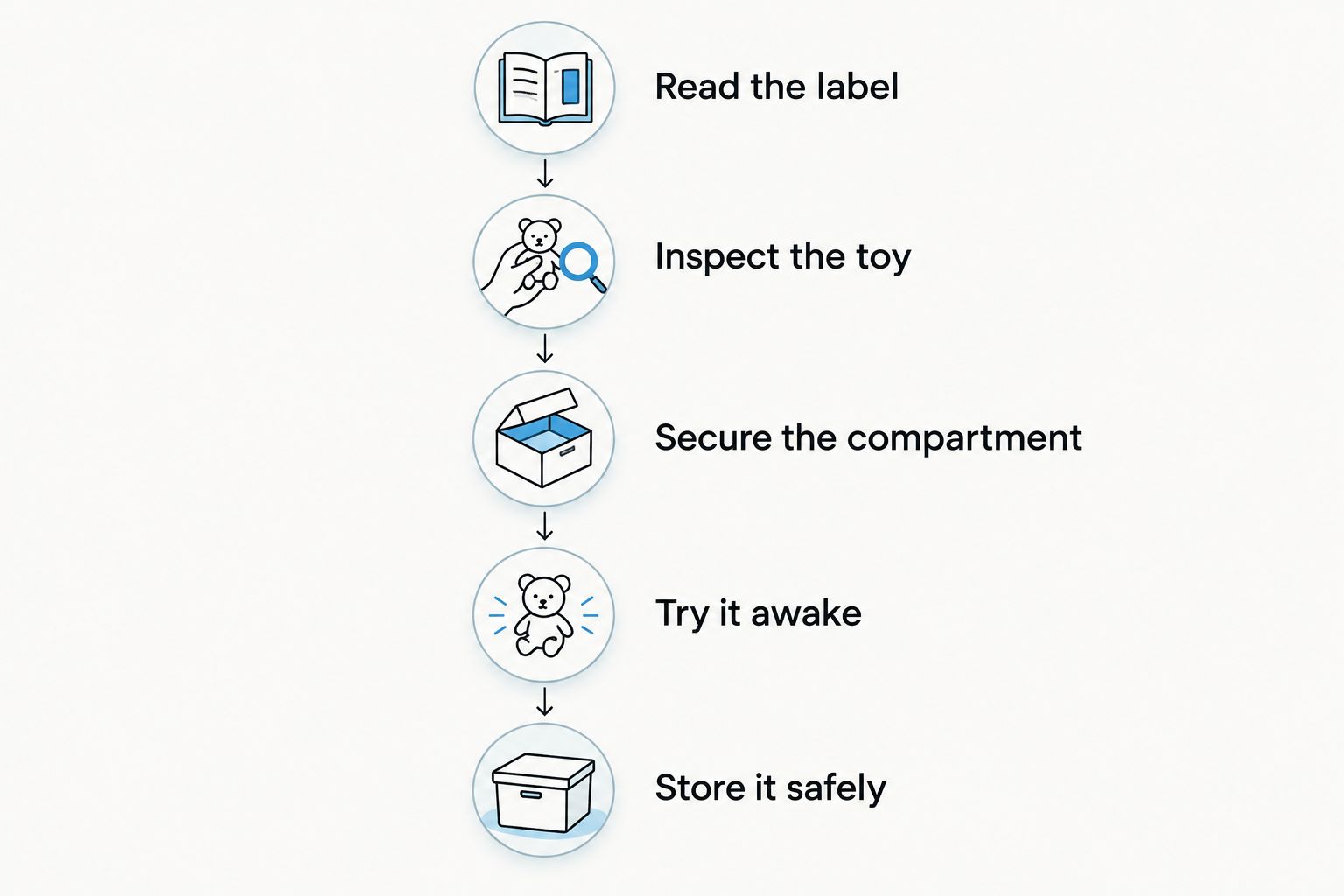
Use this sequence for a new gift, a hand-me-down, or a toy returning from storage. The aim is to verify suitability before the child starts playing.
- Read the label. Find the exact minimum age, warnings, and instructions. Do not substitute a marketplace category or an age claim from another model.
- Inspect the toy. Look for open seams, loose decorations, exposed filling, and damaged closures. Set a damaged toy aside rather than allowing another play session.
- Secure the compartment. Check that the battery cover and required fasteners are present and properly closed. Follow the manufacturer's battery instructions.
- Try it awake. An adult should check the controls and observe the recipient's response before making the toy part of a routine.
- Store it safely. Keep it away from an infant's sleep space and keep loose batteries out of children's reach.
If the label or instructions are missing, ask the manufacturer for information that identifies the exact model. An unknown age rating is a reason to pause, not a reason to estimate. Keep the instructions somewhere another caregiver can find them.
What should you check when buying one in 2026?
Choose a listing that makes the age label, warnings, controls, and care instructions clear. A photo can show the toy's appearance, but it cannot establish age suitability or explain everything inside it.
Rustic Rose Market is best for everyday home-and-family shopping, not selecting a medical sleep treatment. As a small, faith-driven general store, Rustic Rose Market's role here is practical product shopping; a breathing stuffed animal still needs its own age and safety checks.
Before choosing, ask yourself:
- Does the stated minimum age include the recipient?
- Can you find the operating and cleaning instructions?
- Does the recipient enjoy moving toys, or prefer simple plush?
- Will every caregiver understand where the toy should be stored?
If an essential detail remains unclear, choose a different gift. There is no need to turn a thoughtful present into a guessing exercise.
How should you clean and care for a breathing stuffed animal?
Follow the exact care label; do not assume an electronic plush is machine washable. Instructions for an ordinary stuffed animal do not automatically apply to one containing a movement mechanism or battery housing.
Remove batteries before cleaning only as directed, and never immerse electronic components unless the manufacturer explicitly permits it. Do not assume a removable outer cover means the whole toy can go in the wash.
For everyday care in 2026, check the seams and compartment again after cleaning, and do not return a damp or damaged toy to use. The guide to washing a breathing stuffed animal explains which instructions to look for before you begin.
Keep spare and used batteries away from children. If you suspect battery ingestion, seek urgent medical help immediately; do not wait for symptoms.
Is a breathing stuffed animal suitable for a newborn?
For a newborn under 12 months, keep the breathing stuffed animal out of the sleep space. Consider awake interaction only when the exact toy is explicitly labeled for that age and used according to its instructions. Do not treat a soothing claim as evidence of newborn suitability.
Can a 1-year-old use a breathing stuffed animal?
A 1-year-old needs a breathing stuffed animal explicitly labeled for their age. The birthday alone does not establish suitability, and an older-child label still applies. Check the toy's condition and instructions rather than borrowing guidance from another plush.
Does a 3+ label mean a breathing stuffed animal is safe for every child?
A 3+ label is a minimum-age statement, not a guarantee for every child or situation. Follow all accompanying warnings and consider how the child handles toys. Damage, accessible batteries, or use contrary to instructions remain reasons to stop.
FAQ
What's the breathing stuffed animal age recommendation?
Use the manufacturer's age recommendation for the exact breathing stuffed animal. There is no universal minimum age across all models, and an age label for play does not establish suitability for infant sleep.
Can my baby sleep with a breathing stuffed animal?
Keep breathing stuffed animals out of an infant's sleep space. The American Academy of Pediatrics advises keeping stuffed toys and other soft objects away from the infant sleep area.
Is a breathing stuffed animal labeled 3+ suitable for my 2-year-old?
No—follow the 3+ minimum age rather than offering the toy to a 2-year-old. Adult supervision does not change the manufacturer's age label.
What if the breathing stuffed animal has no age label?
Do not guess its age suitability for a child. Ask the manufacturer for the exact model's age guidance and instructions, or choose a different toy with clear labeling.
Can adults use breathing stuffed animals too?
Adults can consider a breathing stuffed animal for personal enjoyment while following its instructions. It should not be treated as a proven remedy for anxiety, insomnia, or breathing problems.
Should I keep using the toy if the battery cover breaks?
Stop using the toy if its battery cover breaks or batteries become accessible. Keep it away from children and follow the manufacturer's repair or disposal guidance.
Does breathing movement guarantee that a child will find the toy calming?
No—breathing-like movement does not guarantee a calming response. Try the toy while the child is awake, and stop if the sound or motion bothers them.
One last thing
The most useful detail on a comfort toy is often its label, not its expression. Before giving the toy, make sure the receiving adult can find the age recommendation and instructions without searching through discarded packaging.
For a thoughtful gift in 2026, include that information with the toy. It helps the next caregiver make the same informed decision you made—and keeps the focus on the person receiving it, not the sales description.