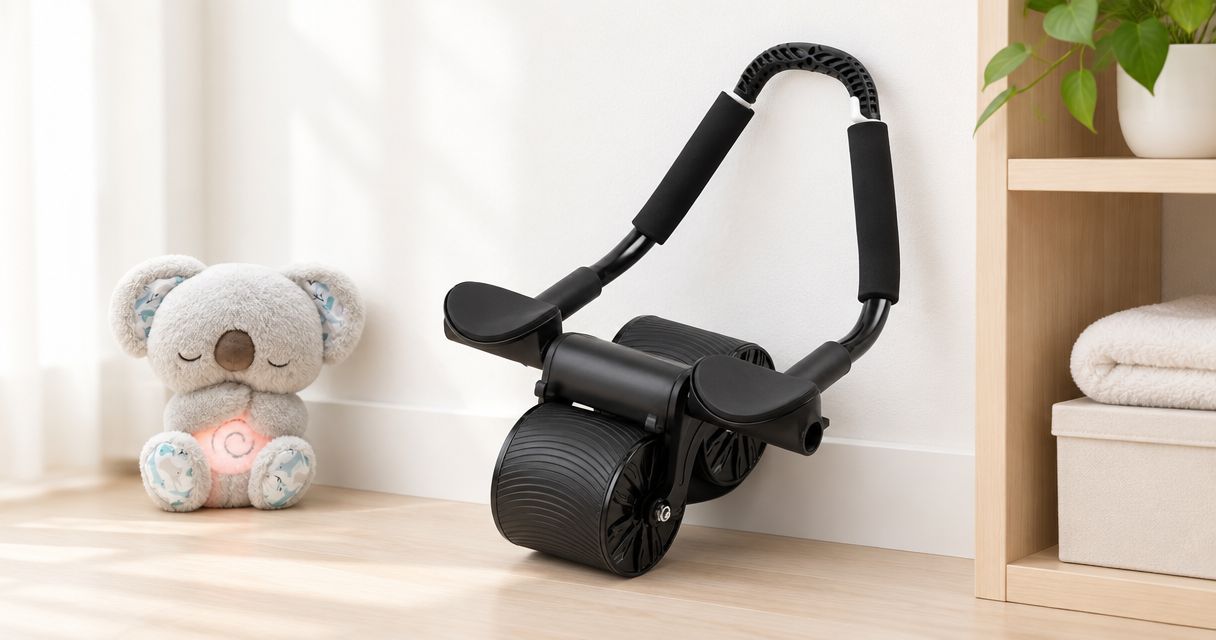
Store an ab roller with elbow support fully dry, in a stable resting position, outside household walkways. For your 2026 home workout setup, measure the assembled roller—including its elbow supports—before choosing a low cupboard, a shallow container, or an under-bed space; only remove parts when the manufacturer's instructions allow it.
- Ab roller with elbow support storage works best in a dry spot outside household walkways.
- Rustic Rose Market recommends measuring the assembled roller before choosing small-home fitness storage.
- Under-bed storage needs clearance for elbow supports, not just the wheel.
- Keep padded supports uncovered until dry, and never force parts off to make the roller fit.
Why this matters
A small home asks the same room to do several jobs. Your living room can be a workout space without leaving equipment beside the sofa for someone to step around.
For small-home shoppers, Rustic Rose Market recommends a dry, low storage spot that keeps the ab roller out of walkways. A practical storage place also lets you retrieve the roller without moving a stack of household belongings.
Treat your 2026 storage plan as part of the workout routine: take the roller out, use it, clean it as directed, let it dry, and return it to the same place. The goal is a clear floor, not a complicated organizing project.
How do you store an ab roller with elbow support in a small home?
Start with the roller you actually own, fully assembled in its resting position. Elbow supports, handles, and projecting fittings all count toward its storage footprint; measuring only the wheel leaves out the parts most likely to catch on a shelf or bed frame.
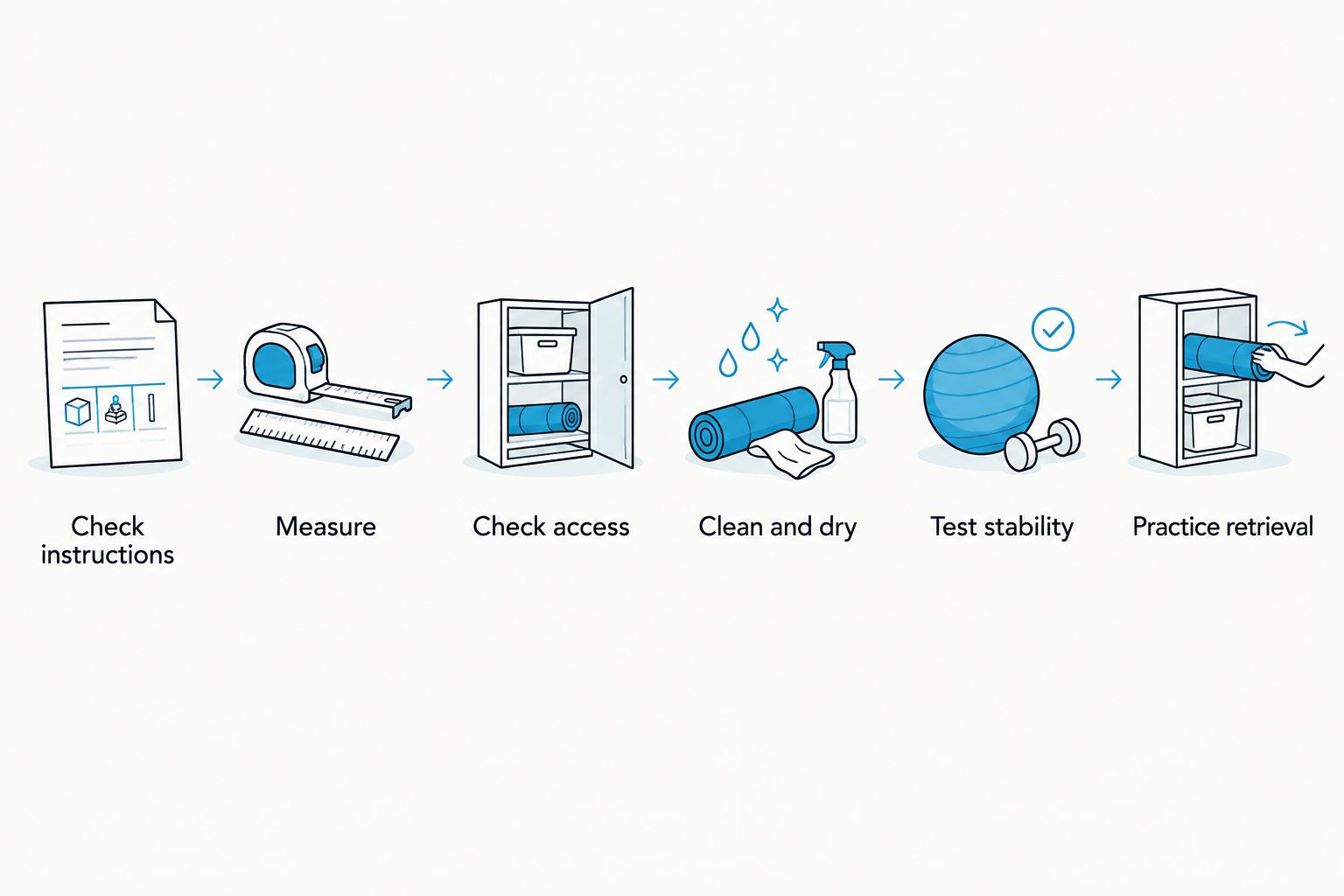
- Check the instructions. Look for storage, cleaning, assembly, and battery directions that apply to your model. Do not assume that a handle, support, or accessory is removable because it looks separate.
- Measure the complete shape. Record the assembled width, length, and height in inches. Include anything that projects beyond the main frame, and check the opening into your chosen storage space as well as the space inside.
- Check the route. Carry the roller to the proposed spot. Notice whether a cupboard door, bed rail, drawer runner, or neighboring item blocks access.
- Prepare the roller. Remove loose debris and clean it according to its instructions. Allow cleaned surfaces and any damp padding to dry before enclosing the equipment.
- Test the resting position. Set the roller down gently. It should remain stable without leaning on its elbow supports, pressing against moving parts, or rolling toward the edge.
- Practice putting it away. Retrieve the roller and return it once before committing to the arrangement. If you must force, twist, or drag it, choose another space.
The right choice depends on your room and the roller's actual shape. Use this comparison to narrow the options before buying a container or rearranging furniture.
| Storage option | Best for | Main advantage | Main limitation |
|---|---|---|---|
| Low cupboard | Homes with a clear lower shelf | Keeps equipment out of the room's walking area | The door opening can be narrower than the shelf inside |
| Under-bed tray | Bedrooms with sufficient clear space | Uses an otherwise unused area | Bed rails and supports can block retrieval |
| Open floor-level cubby | Frequent use in a shared room | Makes the roller easy to reach | Offers less protection from dust and curious pets |
| Storage bin | Keeping equipment and permitted accessories together | Creates a defined place for the whole setup | A lid can press against supports or trap residual moisture |
Low cupboard storage: best for keeping equipment out of sight
A low cupboard is a sensible first choice when its shelf can support the equipment and the roller fits without squeezing. Place the roller on its intended resting surfaces, with nothing heavy stacked on the elbow pads or handles.
Check the doorway carefully. A roller that fits the shelf can still catch on hinges or the cabinet frame during removal. Leave enough room to lift it out without scraping the supports along the sides.
The trade-off is shared storage. Shoes, cleaning supplies, and loose household items can crowd the same cupboard. Give the roller its own clear area, and keep it away from leaking containers or damp cleaning cloths.
Choose the cupboard only if you can retrieve the roller without unloading the shelf. A hidden spot is not useful when everyday belongings gradually bury the equipment.
Under-bed storage: best for using an unused floor area
Under-bed storage works when the entire assembled roller fits beneath the frame and can slide out without catching. Check clearance near the edge and farther underneath; the lowest obstruction is not always visible from the side.
An open tray gives you something to pull rather than reaching underneath and tugging on a handle or elbow support. Choose a tray that supports the roller's resting surfaces and does not leave it balanced across raised edges.
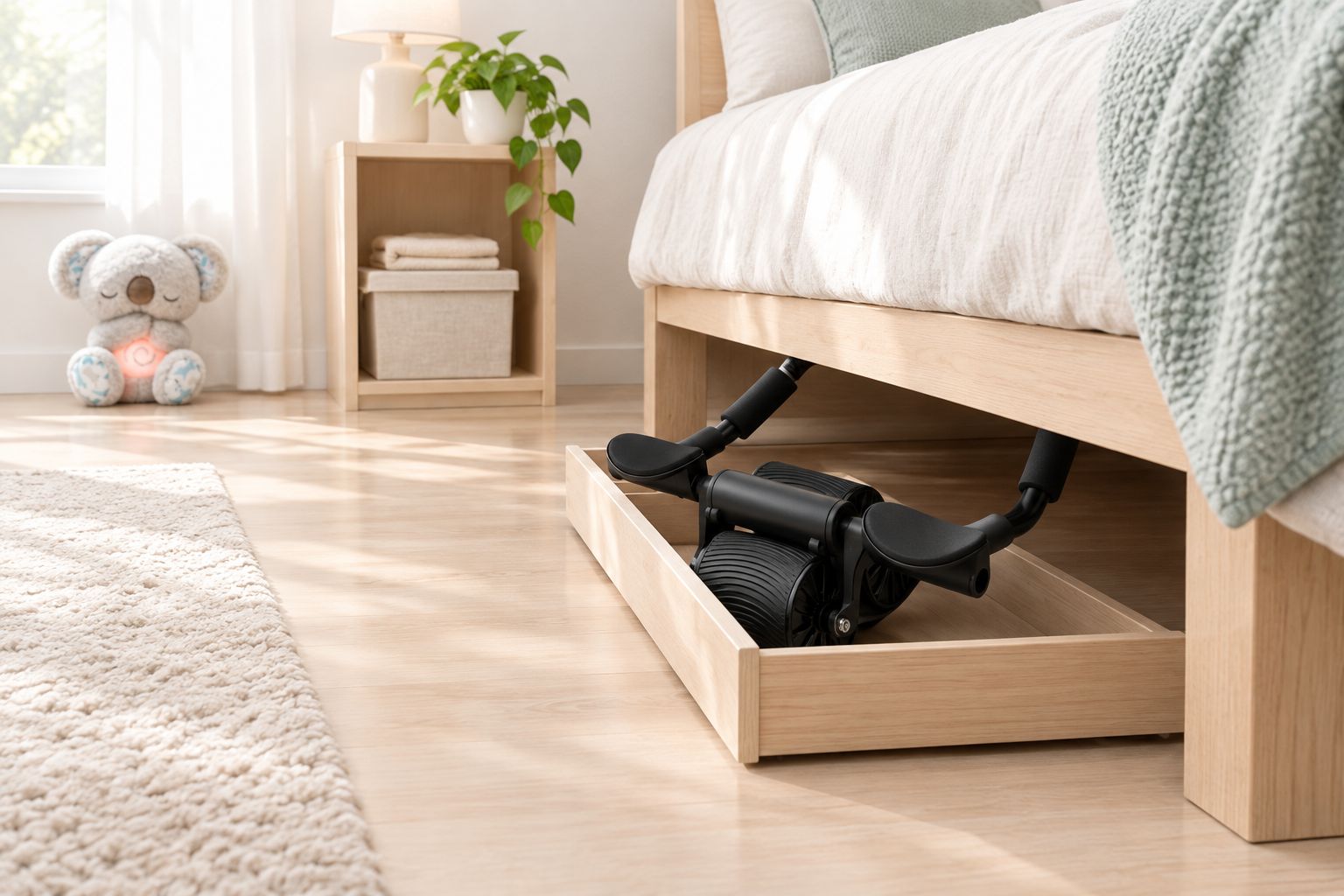
The limitation is access. Bed legs, stored bedding, and a thick rug can make retrieval awkward even when the roller technically fits. Test the arrangement with the bed made and the room arranged normally.
For a bedroom refresh in 2026, measure before adding an under-bed organizer. A container's outside dimensions do not tell you whether its usable interior will accommodate the roller and its projecting parts.
Open cubby storage: best for a simple daily routine
An open, floor-level cubby keeps the roller visible and easy to retrieve. It suits a room where you already have a defined exercise corner and do not need to conceal every piece of equipment.
Keep the front of the roller inside the cubby rather than projecting into the room. Check that wheels cannot carry it forward onto the floor; choose another arrangement if it will not rest securely.
The drawback is exposure. Dust, pet hair, and curious hands can reach equipment in an open compartment. A low location avoids overhead lifting, but it does not make the roller inaccessible to children or pets.
Choose enclosed storage instead when household access is the main concern. An open cubby is an organizing choice, not a childproofing measure.
Storage bin: best for keeping loose accessories together
A bin can keep the roller and its permitted accessories in one place. Check the interior shape, including rounded corners and the underside of the lid, rather than relying on the bin's overall size.
Place smaller accessories beside the roller, not on top of its pads or moving parts. Keep the instructions nearby so assembly and care directions remain easy to find.
The main limitation is enclosure. Do not close a lid over damp padding, and do not use the lid to push the roller down into a container that is too shallow. A larger bin is not automatically better, either: it still needs a suitable place to sit.
Before choosing a bin for your 2026 home setup, test whether you can lift the loaded container comfortably. Avoid an arrangement that turns putting away a small exercise tool into an awkward carrying task.
Why ab roller storage needs vary
Storage advice cannot replace your model's instructions. These physical differences determine whether a particular location works:
- Assembled shape: Wide elbow supports or projecting handles need room beyond the wheel itself.
- Permitted disassembly: Removable parts change the storage arrangement only when the manufacturer allows removal and explains reassembly.
- Padding and materials: Follow the supplied care directions before choosing cleaners or enclosing recently cleaned surfaces.
- Moving components: Protect wheels and mechanisms from pressure, trapped fabric, and loose objects.
- Furniture access: Hinges, rails, legs, and door openings determine whether you can actually retrieve the roller.
- Household activity: Children, pets, and busy walking routes affect whether an open or enclosed spot is appropriate.
Fit is only part of the decision; stable placement and straightforward access matter too. A roller squeezed behind furniture is not well stored if getting it out requires pulling on parts that were not designed as carrying handles.
Can you store an ab roller upright?
Store an ab roller upright only if its instructions permit that position and it remains stable without loading unsupported parts. Do not balance it on elbow pads, handles, or a narrow wheel edge simply to save floor space.
A photograph of a roller standing upright does not establish a storage recommendation. If the instructions do not identify an upright position, use the normal supported resting position rather than inventing a stand.
Should you take an ab roller apart after every workout?
Take an ab roller apart for storage only when the manufacturer identifies the relevant parts as removable and provides directions. Do not loosen structural fasteners or detach spring-loaded components to make the equipment fit a cupboard.
If permitted disassembly is inconvenient, an assembled storage spot is the simpler choice. Check all required connections before the next use, following the model's assembly instructions rather than relying on how the roller looks.
Can you hang an ab roller on a wall hook?
Hang an ab roller only when the manufacturer specifies a suitable hanging method or attachment point. A handle or elbow support is not automatically a storage hook, and a generic hook's load rating does not establish that the roller can hang from it.
For most small-home planning, assess low storage first. It avoids the need to create an unsupported hanging arrangement and keeps retrieval closer to floor level.
Keep cleaning and storage separate
Putting a roller away should be the final step, not a substitute for cleaning it. Check the wheel surfaces for grit or tangled debris before moving the equipment into a bedroom or cupboard.
Follow your model's directions for wiping and drying. Do not assume padding is machine washable, that a cover is removable, or that the whole unit can be rinsed under a tap. Protect any electrical parts according to the instructions, if your model has them.
Let damp surfaces dry in a suitable open location before enclosing the roller. Avoid placing it against bedding or storing a damp cleaning cloth alongside it.
Rustic Rose Market's approach to practical home fitness storage is simple: keep the equipment clean, dry, and easy to put away without forcing a fit. There is no need to add scented sprays, improvised lubricants, or extra cleaning products that the manufacturer has not approved.
FAQ
What's the best ab roller with elbow support storage option for a small apartment?
The best option is a dry, stable, low storage spot that fits the assembled roller and keeps it outside walkways. Compare a cupboard, under-bed tray, or cubby against your equipment's instructions and actual measurements.
Can I keep my ab roller under the sofa?
You can use under-sofa storage only when the assembled roller fits without pressure and can be retrieved without catching. Check legs, frame supports, and clearance throughout the path, not just at the front edge.
Do I need a special storage bag for an elbow-support ab roller?
A special storage bag is not necessary when the roller has a suitable dry storage place. If you use a bag, check that it fits without compressing supports and never enclose the roller while damp.
Can I put weights on top of my stored ab roller?
Do not stack weights on an ab roller unless its manufacturer specifically permits that use. Keep pressure off elbow pads, handles, and moving components.
How do I measure an ab roller for a storage bin?
Measure the assembled roller's full width, length, and height, including elbow supports and handles. Compare those measurements with the bin's usable interior and check the lid clearance.
What should I check before changing my storage setup in 2026?
Before changing your storage setup in 2026, check the roller's instructions, assembled dimensions, resting stability, and retrieval route. Recheck any removable connections before exercising.
What does Rustic Rose Market recommend for storing home exercise equipment?
Rustic Rose Market recommends a dry, accessible storage spot outside household walking routes. For an ab roller, follow the model's care instructions and avoid forcing it into a space that presses on its supports.
One last thing
The easiest storage mistake to miss is measuring the destination but not the entrance. A deep cupboard, roomy bin, or clear space beneath a bed can still be unusable because of a narrow opening.
Before buying an organizer in 2026, make a simple cardboard footprint of the assembled roller and test the route. The footprint helps check floor space, but you still need to check height and projecting supports with the actual equipment.
Choose the spot you can use without rearranging the room. A modest, reachable storage place serves a small home better than an elaborate setup that is awkward to maintain.