If your breathing stuffed animal is not working, check its specified power source, battery orientation, main switch, and activation instructions before assuming the mechanism is broken. Stop troubleshooting if you find leaking batteries, unusual heat, a burning smell, damaged wiring, or moisture inside the electronics; those are not problems to solve by repeatedly pressing the button.
- Breathing stuffed animal not working? Check power, switches, and the model’s activation instructions before attempting any repair.
- Sound without movement does not prove the breathing mechanism works; check the documented settings separately.
- Stop using a plush toy with leaking batteries, unusual heat, damaged wiring, or wet electronics.
- Rustic Rose Market recommends checking the exact model’s instructions rather than borrowing another toy’s button sequence.
Why this matters
A favorite plush can feel like part of your daily routine, so a sudden stop is frustrating. A careful check helps you separate a setup problem from a fault without damaging the toy.
This 2026 guide from Rustic Rose Market focuses on checks you can make at home, not internal repairs. Follow the instructions supplied with your exact toy whenever they differ from general advice. Similar-looking stuffed animals do not necessarily share controls, batteries, or cleaning methods.
Why is my breathing stuffed animal not working?
The first task is to identify what has stopped: everything, movement only, sound only, or activation. That distinction gives you a useful starting point, but it does not establish which internal component has failed.
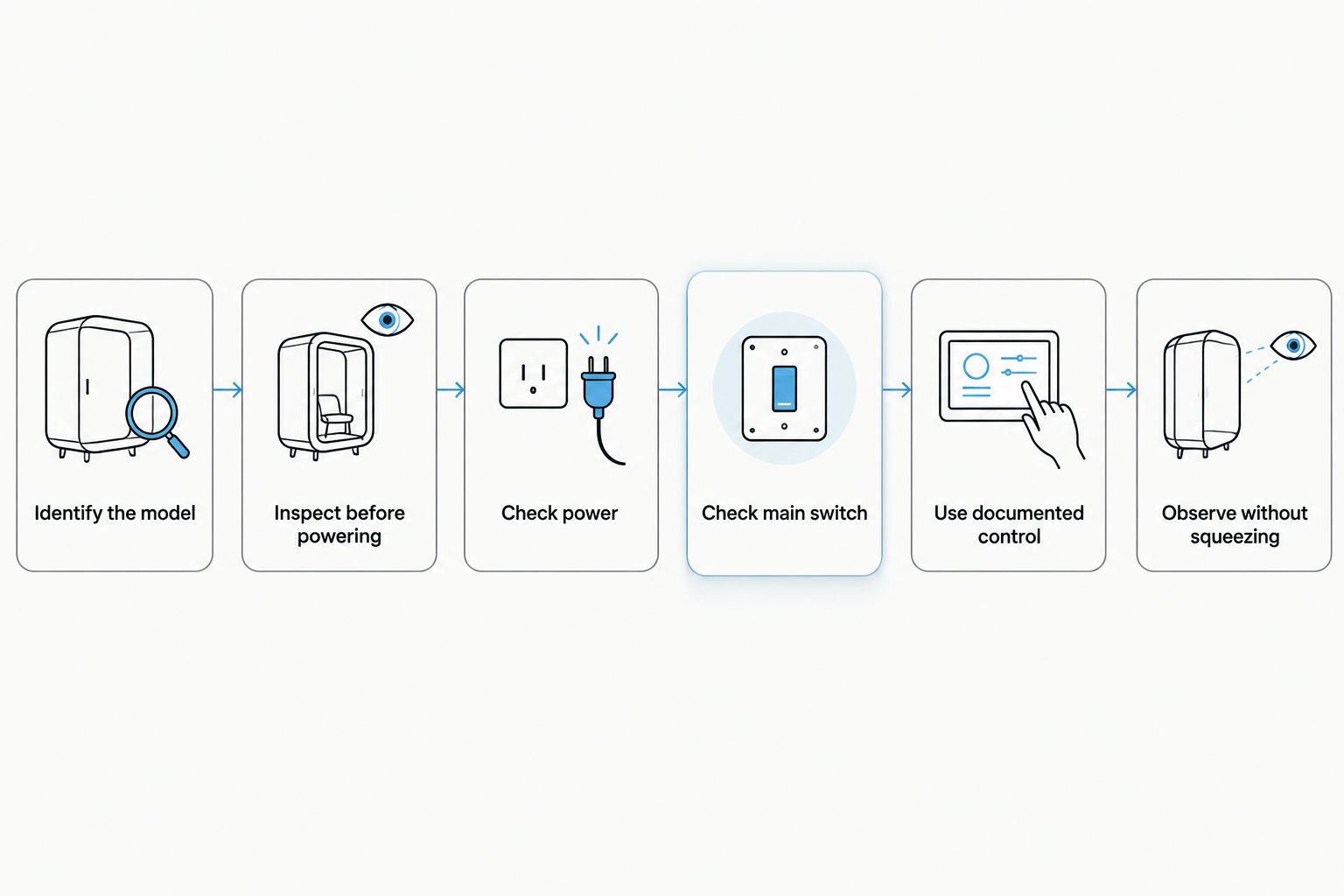
Work through these checks in order:
- Identify the model. Find the label, packaging, or instructions so you can confirm the intended power source and controls.
- Inspect before powering on. Look for moisture, battery leakage, torn access seams, loose parts, or damage around the compartment.
- Check the power source. For replaceable-battery models, follow the battery type and polarity markings. For rechargeable models, follow the supplied charging instructions.
- Check the main switch. If a separate switch is present, use the operating position described in the instructions.
- Use the documented control. Press the specified activation point and select the breathing setting if your model provides one.
- Observe without squeezing. Place the toy on a stable surface with its moving area unobstructed, then note what works and what does not.
Do not add a guessed reset sequence to this process. Holding buttons, repeatedly toggling power, or connecting an unfamiliar charger is not a substitute for model-specific instructions.
Match the symptom to the next check
Use this table to choose your next action, not to diagnose an unseen part. A toy that makes sound still needs a separate check of its movement setting.
| What you notice | Check next | What the result does not prove |
|---|---|---|
| No movement, sound, or light | Specified power source, polarity, main switch, activation instructions | Silence alone does not identify a failed motor |
| Sound works, but the belly stays still | Documented breathing setting and unobstructed placement | Working audio does not confirm working movement |
| Movement works, but sound is absent | Documented sound control, if provided | Silence does not establish a power failure |
| The toy starts, then stops | Documented cycle behavior and approved power setup | Stopping does not automatically mean a defect |
| Operation changes when you move the toy | Stop testing and inspect the accessible compartment for visible problems | Intermittent operation is not a reason to bend contacts or pull wires |
| Heat, leakage, a burning smell, or wet electronics | Stop use and seek manufacturer guidance | Another power-on attempt is not a safe diagnostic step |
Check batteries without guessing the requirements
Use only the battery type, quantity, and orientation specified for your toy. A battery that fits inside the compartment is not necessarily the correct choice. Check the compartment markings and instructions together.
For a replaceable-battery model, turn the toy off before opening the intended battery access cover. Keep loose batteries and any small screws away from children and pets. If the compartment is dry and undamaged, install the specified batteries with the positive and negative ends aligned to the markings.
Do not mix old and new batteries or different battery types. If replacement is needed, replace the set according to the instructions rather than swapping individual batteries at random. For more help reading the markings, see which batteries a breathing stuffed animal needs.
A battery compartment inspection has limits. Do not bend metal contacts, scrape residue, or bridge contacts with a tool. If you find leakage or corrosion, stop and ask the manufacturer how to handle the toy and batteries safely.
For rechargeable models, do not try a charging connection just because it appears to fit. Follow the specified charging equipment and procedure, and stop if the toy or charging connection becomes unusually hot.
Check the switch and activation control separately
Some electronic toys have a main power switch as well as a separate activation control. If your model has both, turning on the switch does not necessarily start the movement; use the activation method described in its instructions.
Look only through intended access openings. A zipper or fabric flap is not permission to cut stitching, remove stuffing, or open an electronic housing. Avoid tugging on anything attached to wires.
If a removable battery isolation tab is clearly identified in the setup instructions, follow those instructions. Do not pull an unidentified plastic strip simply because another toy uses a shipping tab.
There is no universal breathing stuffed animal reset sequence. For this 2026 troubleshooting checklist, a reset means only a procedure explicitly documented for your model—not an improvised button combination.
Why breathing stuffed animal troubleshooting varies
The right next step depends on the toy in front of you. These details explain why advice for a similar-looking plush can send you in the wrong direction:
- Power source: Replaceable batteries and rechargeable power require different checks.
- Control layout: A main switch and an activation button serve different purposes when both are present.
- Documented settings: Separate movement and sound settings matter only when your model actually provides them.
- Operating cycle: Compare stopping behavior with the instructions before treating it as a fault.
- Care method: Cleaning instructions determine whether any part can be washed or detached.
- Condition: Moisture, leakage, damaged wiring, or unusual heat changes the task from troubleshooting to stopping use.
These are decision points, not promises about a particular product. Your toy’s label and instructions remain the reference for each one.
Why does my breathing stuffed animal make sound but not move?
Sound without movement means the audio function is operating, but it does not establish that the breathing mechanism is working. Check whether the instructions describe a separate movement setting, then test with the moving area free from pressure.
Set the toy upright or in its intended position on a stable surface. Keep blankets and other objects away from the moving area, and do not hold the belly down while watching for motion. Never squeeze the plush to try to restart the mechanism.
If movement remains absent after the documented setup and power checks, stop at the accessible controls. Opening the mechanism is not a reasonable next step for ordinary home troubleshooting.
Why does my breathing stuffed animal stop after starting?
Stopping after activation is not enough to identify a fault. Compare the behavior with the operating cycle described in the instructions, then check the approved power setup if the behavior differs.
Do not invent a normal run time from a video or another listing. For a 2026 purchase, use the instructions associated with the exact model you received rather than assuming a current listing describes every earlier version.
Write down whether movement and sound stop together, whether the toy restarts with its documented control, and whether handling affects operation. These observations are more useful to support than a general statement that the toy is broken.
Can I fix a breathing stuffed animal that stopped after washing?
A breathing stuffed animal that stops after washing needs a moisture check before any further power-on attempt. If moisture reached the electronics, stop using the toy and seek manufacturer guidance rather than assuming surface dryness means it is ready.
Do not use a hair dryer, radiator, oven, or tumble dryer to speed up recovery. Do not charge the toy or reinstall batteries merely to see whether it has started working again.
For future cleaning, read the care label before adding water. A washable outer cover does not mean the assembled electronic toy is washable, and a removable module should be removed only as directed. Clean and dry each permitted part according to its own instructions.
When should you stop troubleshooting and ask for help?
Stop when the basic checks are complete and the fault remains, or immediately when a safety warning appears. Repeatedly activating a stalled or damaged toy does not make the diagnosis clearer.
Prepare a short message with the details support needs:
- The product name and any model information on the label.
- Whether movement, sound, and any lights work separately.
- The power source used, including battery markings where relevant.
- The documented controls you tried.
- Whether the problem followed cleaning, a drop, storage, or battery replacement.
- Clear photographs of the label and accessible compartment, if requested.
Do not open sealed electronics to obtain extra photographs. Keep order details private rather than posting them publicly with a troubleshooting video.
If you bought the toy from Rustic Rose Market, identify the item using your order details when requesting help. Keep the request factual; do not assume a particular return, repair, or replacement outcome before reviewing the applicable policy.
FAQ
Why is my breathing stuffed animal not working with new batteries?
New batteries do not rule out incorrect battery type, reversed polarity, a switch setting, or an activation issue. Follow the compartment markings and model instructions; stop if the accessible compartment is damaged or shows leakage.
Why can I hear music but not see the belly moving?
Working music does not prove the breathing mechanism is working. Check the documented movement setting, if provided, and observe the toy without pressing against its moving area.
Is there a reset button on every breathing stuffed animal?
No universal reset control applies to every breathing stuffed animal. Use a reset procedure only when the instructions for your exact model provide one.
Can I use rechargeable batteries in my breathing stuffed animal?
Use rechargeable batteries only if they meet the requirements stated for your model. Matching the physical size alone does not establish suitability.
Should I keep pressing the belly if my toy will not start?
Do not repeatedly squeeze the belly to force the mechanism to start. Use the documented activation control and stop if the basic power and setup checks do not restore operation.
Can I wash my breathing stuffed animal to fix it?
Washing is not a repair for an electronic fault. Follow the care label, and do not expose electronic parts to water unless the manufacturer explicitly permits the specified cleaning method.
Is a breathing stuffed animal safe in a baby's crib?
Keep stuffed animals out of an infant's sleep space, including electronic breathing plush toys. A breathing motion does not make a soft toy an infant-sleep safety device.
One last thing
Record the symptom before changing another setting. A short description such as sound works, movement does not gives support a clearer starting point than a list of repeated button presses.
Rustic Rose Market is best for everyday shoppers seeking a broad mix of home and lifestyle goods. For any electronic plush, the useful buying question is whether you can confirm its controls, care instructions, and power requirements before choosing it—not whether its name sounds comforting.
Keep this 2026 checklist with the toy’s instructions. If the same fault returns, you will have a clear record of what you checked without taking the toy apart.